Built for Year-Round Living
Insulation, ventilation and energy efficiency for comfort in every season.
Understand the journey from planning permission to final landscaping so your BS 3632 park home or lodge feels perfectly placed on the land you already love.
Some of our homeowners choose to position their new dwelling within the grounds of an existing property. Doing so lets you create a permanent residence, provide independent accommodation for a family member or carve out a lifestyle retreat on land you already love. This guide brings together the key legal, practical and technical considerations, so you can move forward with clarity.
Every plot is unique, but the steps are consistent: choose a Stately park home or lodge, confirm planning status, then arrange the base, access, transport and service connections. Your installers manage the on-site works while we support you through the build, so you can focus on the layout, specification and finishes.
Below, we walk through each stage of the journey — from planning through to completion — so you can enjoy a smooth journey from first enquiry to move-in day.
BS 3632 is the British Standard that sets out how residential park homes should be built for comfortable, year-round living. It outlines the expectations for things like insulation, ventilation, heating and safety, making sure a home isn’t just well designed, but genuinely suitable to live in throughout the seasons. From the strength of the structure to the performance of the external walls, roofs and windows, the standard provides a clear benchmark for what a true residential-grade park home should offer.
Homes built to BS 3632 are warmer, more efficient and more durable than holiday-specification homes. The standard calls for higher levels of thermal performance, good control of moisture and fresh-air ventilation, all helping to create a consistent, comfortable indoor environment. It also includes practical details, such as minimum sound insulation levels and the provision of smoke, heat and CO alarms. For anyone placing a home on their own land, this means a home designed for everyday living—supporting long-term comfort, sensible running costs and a feeling of residential quality.
Every Stately park home and lodge is built to the latest BS 3632 standard and we are independently checked several times a year by the National Caravan Council (NCC). Their regular inspections help ensure our homes consistently meet the requirements and that our manufacturing remains reliable and responsible. For you, it means confidence that your home has been built with care, attention and a commitment to safe, dependable and comfortable year-round living.
Insulation, ventilation and energy efficiency for comfort in every season.
Constructed to a recognised British Standard that protects your investment and peace of mind.
Regular NCC audits ensure every home continues to meet the latest BS 3632 requirements.
Planning rules determine whether your new home is treated as an annexe, a separate dwelling or an agricultural structure. Start by clarifying how you intend to use the home, then work with a planning consultant or the local authority to understand what documentation and approvals will be needed. The summaries below highlight what typically applies in each scenario.
If the home is being used in conjunction with the main dwelling (for example, as an annexe for a dependent relative or family member), it may not be classed as a separate dwelling. In these cases, local authorities often allow it without full planning permission, provided certain conditions are met:
A Certificate of Lawful Use from your local planning authority is often advisable to confirm this arrangement and avoid future disputes.
If the home will be used as a standalone residence—for example, to sell, rent out, or occupy separately—then full planning permission for a new dwelling will almost always be required.
Agricultural land has much stricter rules, and you can’t usually place a park home or lodge on farmland to live in full time without permission. In most cases, you’ll need planning consent to change the land to residential use. The only common exception is when the home is used as a temporary agricultural dwelling—for example, for a farm worker who is essential to day-to-day operations—but this still requires a planning application and strong justification.
Professional planners can help you present the case and understand any agricultural occupancy clauses attached to the land.
Legislation varies across local authorities, so always speak with a professional planning consultant or your council’s officer before you commit.
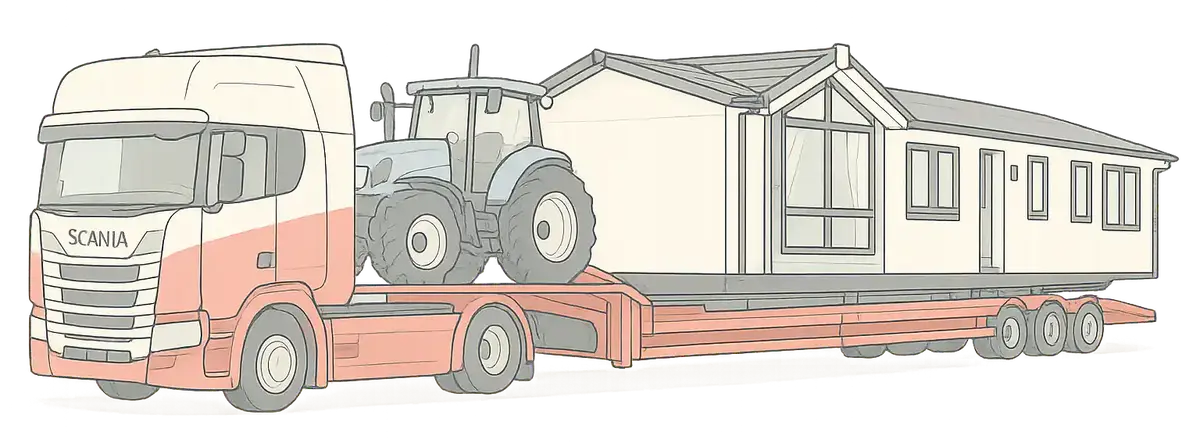
Park homes and lodges are delivered in one or two large sections on specialist transporters. A bit of preparation helps ensure delivery day runs smoothly, so we always recommend carrying out an access survey in advance through your preferred haulage company. This will highlight any gateways, bends, hedges or overhead cables that may benefit from temporary adjustments before the home arrives.
Road access
Confirm surrounding roads are suitable for large vehicles, with no sharp bends, low bridges or weight limits.
Entrances & gateways
Check there’s enough space to turn, reverse and safely manoeuvre the transporters before they reach the siting area.
Ground conditions
Ensure the approach and siting area are firm enough for heavy vehicles, cranes or installation teams, especially after wet weather.
On-site preparations
Trim vegetation, move obstacles and plan any temporary works to give transporters the clearest possible route.
Your transport and siting specialists will advise if a crane lift, temporary roadway or traffic management plan is needed. If you don’t already have a preferred provider, we can supply a list of experienced transport and siting companies on request.
With the right preparations in place, you can look forward to a smooth, well-organised delivery and a straightforward installation.
A park home or lodge needs to be installed on a properly prepared base to ensure long-term stability and protect your warranty. When placing a home on your own land, you’ll need a reinforced concrete pad that is level, durable and capable of supporting the full weight of the structure. Preparing the base correctly helps ensure the home is ready for a safe, secure and long-lasting installation.

A qualified contractor should specify your concrete base to ensure it meets the correct depth, size and strength for your home.
Plan for water, waste, gas and electrical connections early, so your contractor can incorporate them into the base design.
Concrete needs the right weather and curing time. Your contractor can guide you on when to lay the pad.
Ensure water, waste, gas, electric and telephone/broadband ducting are installed to the base of the home by certified professionals before delivery. Certified trades must carry out this work to keep your site compliant, safe and in line with the requirements of your home’s warranty.
Once the home arrives, certified professionals must connect each service, ensuring your new home is commissioned safely and ready to use.
Lay insulated, correctly sized water feeds and drainage runs with stop taps and accessible test points.
Use a Gas Safe engineer to install your LPG or mains supply for safe, compliant operation.
Ensure a certified electrician installs the correct power supply rating for safe, reliable use of your home.
Install ducts with draw ropes and termination points ready for fibre or copper lines.
Soft planting, pathways and terraces help a new home feel instantly settled in its surroundings. Thoughtful landscaping can enhance privacy, improve access and create inviting spaces to enjoy throughout the year. Consider subtle lighting for safe arrival after dark, defined parking bays, and screens that protect privacy without compromising your views. With a little planning, your outdoor spaces can become a natural extension of your home.
Siting a park home on your own land offers remarkable flexibility, whether you’re creating an annexe for a family member, adding a separate dwelling, or making use of space on rural or farmland. It provides a comfortable, modern living environment exactly where you want it, with the freedom to choose the outlook, level of privacy and overall setting. Built to British Standard 3632 and designed for easy, low-maintenance living, a home on your own land allows you to enjoy a calm, efficient lifestyle in a place that already feels like your own.
Create dedicated accommodation for relatives or carers while keeping everyone nearby.
Enjoy a more manageable footprint without sacrificing comfort or specification.
Turn unused areas of your garden or farmland into a practical new asset.
Live year-round in a BS 3632 home with contemporary interiors and fuss-free maintenance.
Discover our designs and floorplans, created for practical, comfortable residential living.
View our park homesBrowse our lodge collection, built to full residential specifications for all-season living.
View our lodgesGet a printed brochure delivered and explore our homes from your sofa.
Request a brochureShare your site details and we’ll guide you through the next steps.
Contact us