As energy costs and sustainability become increasingly important considerations for homeowners, interest in solar PV (photovoltaic) systems is growing among park home and holiday lodge owners. A solar installation can help you generate your own electricity during daylight hours, reduce reliance on purchased power, and—when paired with battery storage—make better use of what you generate.
This article explains the key equipment involved, the main design factors in the UK, and how the site’s electricity network can affect your ability to export electricity back to the grid.
Why add solar to a park home or lodge?
A well-sized solar PV system can:
- Reduce daytime electricity costs by powering your home directly from sunlight.
- Increase energy independence, especially when combined with a battery.
- Smooth out peaks in usage, helping you rely less on imported electricity.
- Support a more efficient, modern specification for new homes.
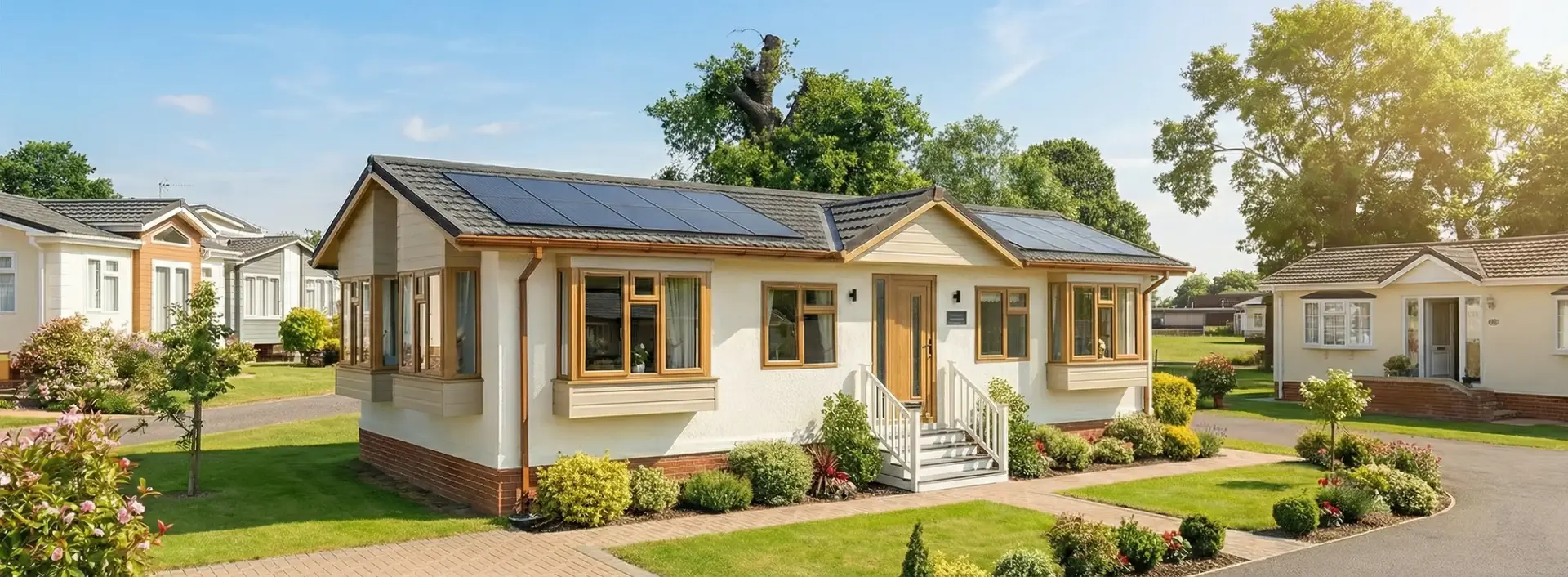
Solar works particularly well when it’s planned in from the start—roof space, cable routes, inverter location and battery placement can all be designed neatly into the home.
The equipment: what makes up a solar PV system?
1) Solar panels (PV modules)
Solar panels convert daylight into DC (direct current) electricity. Modern panels are designed to perform in a wide range of conditions—including cloudy UK days—though output will vary across seasons.
When considering panels, the key differences usually come down to:
- Power rating (W) per panel.
- Efficiency (how much power a panel produces per square metre).
- Aesthetics (factory-installed panels can be roof-integrated for a sleeker finish).
The best approach is to size the system to suit roof space and expected usage, rather than chasing the biggest number possible.
2) Inverters and hybrid inverters
Your home uses AC (alternating current) electricity, so the inverter is the “translator” that turns the panels’ DC electricity into usable AC power.
- A standard inverter converts solar generation to AC for immediate use in the home.
- A hybrid inverter can also manage battery charging and discharging, making it a popular choice where battery storage is included.
Inverter capability can vary. Essential, cost-effective models focus on simply converting electricity. More premium inverters can offer features such as data logging, more detailed performance information, and app connectivity so you can keep an eye on generation and usage over time.
3) Batteries (home energy storage)
Batteries store excess solar energy generated during the day so you can use it later—typically in the evening when household demand often rises.
Batteries are especially valuable when:
- Your lifestyle means you’re not home all day to use solar as it’s generated.
- Your park’s electrical setup limits export back to the national grid.
- You want to maximise self-consumption and reduce imported electricity.
A battery won’t make you “off-grid” in most scenarios, but it can significantly increase the proportion of your electricity that comes from your own roof.
4) Solar panel optimisers
Optimisers are small devices fitted to individual panels (or pairs of panels), designed to improve performance when panels don’t all receive the same amount of light.
They’re particularly useful where:
- Part of the roof is shaded (trees, tall posts, nearby buildings, roof features).
- Panels must be split across different roof faces (e.g., east and west).
Optimisers don’t magically create extra sunlight—but in the right circumstances they can help reduce the impact of shading and improve overall system performance.
Key UK design factors to consider
1) Roof orientation: south, east, and west (and why not north)
In the UK, the sun travels across the southern half of the sky for most of the day. That’s why south-facing panels typically produce the highest annual generation: they spend more time facing the sun as it moves from east to west.
East- and west-facing roofs are also very suitable:
- East-facing panels catch more of the morning sun, which can be useful if you tend to use electricity earlier in the day.
- West-facing panels generate more later in the day, which can better match afternoon and early evening usage.
A north-facing roof in the UK is usually the least suitable because it faces away from the strongest, most direct sunlight. North-facing panels can still generate some electricity in bright conditions, but output is typically much lower, so they’re rarely the first choice unless roof options are limited.
2) Shading: what it does, why it happens, and how optimisers can help
Shading is one of the biggest performance factors for any solar PV system. It can be caused by nearby trees, tall posts, buildings, roof features, or even seasonal changes—like the sun sitting lower in the sky during winter, which creates longer shadows.
In simple terms: a solar panel system works best when all panels are getting similar daylight. When part of the array is shaded, that shaded section produces less electricity. Because panels are often linked together to feed a single system, one shaded panel can reduce the performance of other panels connected with it, a bit like a “weak link” in a chain. The result is that the whole system may generate less than you’d expect from the number of panels on the roof.
This is where optimisers can help. They allow panels to perform more independently, so if one panel is shaded, it has less effect on the output of the others. They’re not always required, but they’re well worth considering if your roofline or surroundings aren’t clear and open.
3) Park electrical networks
Many parks have a private on-site electricity network: one main incoming supply from the national grid is distributed across the park, and the park operator then meters each home’s usage privately. In this setup, homeowners usually can’t export electricity back to the national grid, because the home doesn’t have its own dedicated grid export arrangement and meter.
In practical terms, that means:
- You may still generate solar power and use it within the home.
- Selling excess electricity back to the grid may not be available on many parks.
- Your best value often comes from using more of what you generate, rather than exporting it.
That’s why battery storage can be a smart pairing on parks with private networks: it helps you store surplus daytime generation and use it later, increasing self-consumption.
4) What is the DNO and why is approval sometimes needed?
The Distribution Network Operator (DNO) is the organisation responsible for the local electricity distribution network in your area—the cables, substations, and equipment that deliver electricity from the grid to your property.
For any grid-connected solar or battery system, the DNO must be informed. The process depends on where your home is located:
On Private Land (Direct Connection)
If your home is on private land with its own electricity meter and bill from a supplier (like Octopus or British Gas), you likely have a standard connection.
- Small systems: For standard home systems, it is often a simple “fit and notify” process. Installers fit the system and registers it with the DNO afterward.
- Larger systems: If you want a large array with an inverter rated above 3,600 W (16 A), the installers will need to apply for approval before connection.
On a Park (Private Network)
On most parks, homes are supplied via a private network fed by one main bulk connection from the national grid.
- The Park Owner is the 'Customer': The DNO views the entire park as one single connection. Therefore, the park operator is usually the one who must handle DNO applications.
- Cumulative Limits: The DNO looks at the total generation on the park. One home having solar is usually fine, but fifty homes doing it might overload the park's main supply.
- The Battery Solution: If the DNO says the park cannot export any more power to the grid, you may still be able to install solar if you use a battery and an 'export limitation' device. This ensures you store your excess energy rather than sending it back to the grid.
5) What if the grid is "full"? Understanding Export Limitation
Sometimes, the DNO may grant permission for you to generate electricity but refuse permission for you to export it back to the grid. This is common on parks where the main connection cable is already running near its maximum capacity.
The solution is a technology called Export Limitation.
How it works:
A small sensor (called a CT clamp) is fitted around the main electricity cable coming into your home. This sensor talks to your solar inverter or battery system in real-time.
- Normal Operation: If your home is using all the solar power you are generating (e.g., the kettle is on), the system runs at full power.
- Throttling Back: If you turn the kettle off and the solar power has nowhere to go, the sensor detects that electricity is about to flow out to the grid. It immediately signals the inverter to reduce its output or divert that spare energy into your battery.
This satisfies the DNO's safety requirements while allowing you to have solar panels even in areas with "constrained" grid connections.
6) Where does the equipment go?
Finding a safe home for the “brain” (the inverter) and the battery is just as important as where the panels sit on the roof.
In 2024, the UK introduced new safety guidance (PAS 63100) for battery storage. While the technical details are complex, the goal is simple: to keep high-power batteries away from living spaces and escape routes.
The “No-Go” Zones
Under this modern guidance, we generally avoid installing batteries in:
- Roof voids: In park homes, roof spaces are often insulated timber voids that can get warm in summer. Excessive heat damages battery health, and these spaces are difficult to access safely.
- Hallways & Exits: Equipment cannot block or be located in your primary escape routes (like the main corridor or hallway).
- Living areas: Batteries should generally be kept out of bedrooms and habitable rooms.
Our goal is to always try to fit the solar equipment into the existing design of your home to minimise additional cost. However, where we cannot do this for safety reasons, one solution is to build an integrated outbuilding attached to the exterior of the home if the home plot allows.
- Safety First: This keeps the battery and inverter outside the main living area, complying with fire safety and ventilation guidance.
- Weatherproof: The equipment is housed safely away from the elements but remains easily accessible for maintenance.
- Neat Design: Because we design this from the factory, it blends seamlessly with your home’s exterior.
7) UK seasons: what to expect through the year
Solar PV is productive year-round, but it is seasonal in the UK:
- Spring and summer typically bring much higher daily generation due to longer daylight hours and stronger sun.
- Autumn and winter have shorter days and lower sun angles, so generation is reduced—even if panels remain efficient.
A sensible system design considers your typical usage pattern across the year. Batteries can help year-round, but they’ll naturally be filled more easily in brighter months.
Solar on new Stately homes
We can incorporate solar PV into new build park homes and lodges during manufacture, helping ensure the system is neatly integrated and professionally installed. Our in-house electricians are MCS certified, giving added reassurance that the work is carried out to recognised standards.
Please note: We do not currently offer a retrofit service to install solar panels onto existing homes on site. Solar installation on an already-sited home is typically influenced by access, roof condition, park rules, and the park’s electrical network—so we focus our offering on new homes being built.
Interested in a new home with solar?
If you’re specifying a new Stately park home or lodge, we can discuss solar PV options—panels, inverter type, battery storage, optimiser suitability, and design requirements—so your home is ready to make the most of the energy it generates.